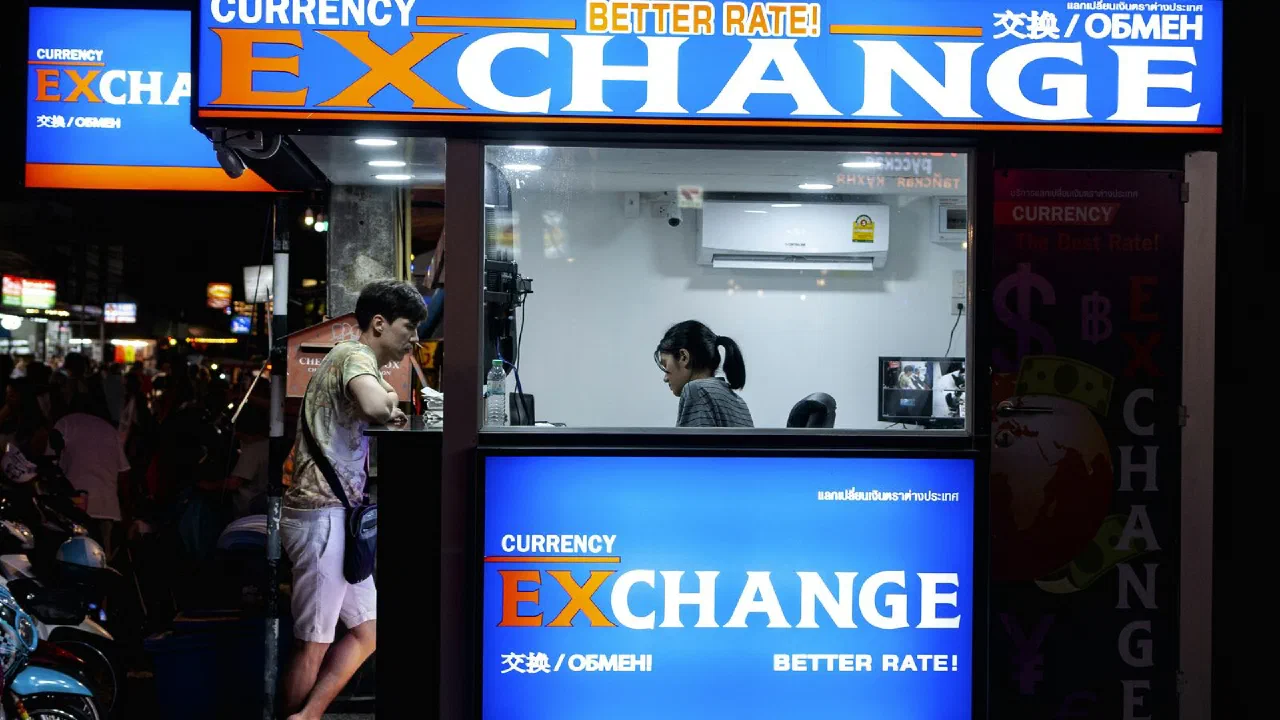
A refund operator converting your refund charges 3% to 5% of it. A card network doing the same conversion on the same money charges 1.0%. That gap is the second-largest deduction in the whole tax-free sum after the service fee itself, it is bigger than every airport fee and scheme charge put together, and it is the only line on the form you can remove entirely by answering one question differently at the desk.
On the €1,000 French purchase in the ladder above it is worth between €2.50 and €5.00. On a €5,000 purchase it is worth between €12.50 and €25.00. Nobody at the counter will raise it.
The currency conversion fee on a VAT refund, as published
Global Blue’s published terms, reproduced verbatim by TravelUpdate on 20 March 2023, put it at “a currency conversion fee of 3% to 5% of the refund amount in original currency,” applied when the refund currency differs from the currency the Tax Free Form was issued in. The same terms describe the rate itself as the company’s own “we sell” rate — based on a recognised European retail bank’s selling rate, with the 3% to 5% on top.
Two things about that construction are worth separating, because they are usually conflated.
The fee is the 3% to 5%. The rate it sits on top of is a retail bank’s selling rate, which is already not the interbank mid-market rate — a retail “we sell” rate carries its own margin before anybody adds anything. So the published band understates the distance from mid-market rather than overstating it. I am not going to put a figure on that second layer, because no source I can open publishes one, and inventing a spread would be exactly the sin this site exists to correct.
I could not read Global Blue’s live terms on 4 September 2026 — its customer-services site returned a 503 error on every attempt that day, which is why the citation above is a dated third-party reproduction rather than the page itself. Planet’s own Tax Free FAQ, which I could read that day, does not state a conversion charge at all; it says only that “the exchange rate used may change over time.” An unstated charge is not an absent one.
What the same conversion costs when a card network does it
Here is the benchmark, and it comes from a source with no stake in tax-free shopping at all.
The US General Services Administration publishes GSA SmartPay Smart Bulletin No. 007 on foreign currency conversion, last revised 22 March 2024. It states the network-level fees directly. For Visa: “VISA® charges the ISA on foreign purchase transactions requiring currency conversion,” and “if the purchase is made in another currency and then converted to U.S. dollars, the ISA fee is 1.0%.” For Mastercard: a cross-border fee of 0.8% where no conversion is needed, and where there is one, “MasterCard® applies a 1.0% fee.” The bulletin also states how the rate underneath is set — “the most favorable conversion rate established by an interbank rate or, where required by law, an official rate.”
That is the whole comparison. One per cent, on an interbank-derived rate. Against three to five per cent, on a retail bank’s selling rate.
| Who converts | Published fee | On €125.00 |
|---|---|---|
| Visa, converting to the card’s currency | 1.0% (ISA) | €1.25 |
| Mastercard, converting | 1.0% | €1.25 |
| Mastercard, no conversion needed | 0.8% (cross-border) | €1.00 |
| A refund operator | 3%–5% | €3.75–€6.25 |
One caution on reading that table. Your card issuer may add a foreign transaction fee of its own on top of the network’s — that is set by the issuer, not by Visa or Mastercard, and it varies enough that no single figure is honest. Check your own card’s schedule; it is printed in the terms, and it is the reason the card-side line in what a VAT refund actually pays is labelled as your card’s number rather than a universal one. The 1.0% above is the network’s fee for the act of conversion, which is the like-for-like comparison against the operator’s 3% to 5%.
How to make the line disappear
The fee applies when the currency you are paid in differs from the currency of the form. So it does not apply when they match. That is the entire technique.
Ask for the refund in the currency the form is denominated in. A French form is a euro form. Paid to a euro-billed account, no conversion happens and no conversion fee is charged. If you then need those euro as dollars, your own bank or card network converts them at the rates above, and you have replaced a 3%–5% charge with a 1% one.
Know which card you are handing over. Global Blue’s published terms say a card refund “will be credited in the billing currency of your credit card” — so handing over a dollar-billed card is the instruction to convert, whether or not anyone says the word. Choosing a euro-billed card, where you have one, is the same decision made the other way.
Refuse the home-currency offer at the desk. Being offered your refund in your own currency at a foreign counter is dynamic currency conversion, the same mechanism sold as a convenience. GSA’s bulletin advises cardholders to avoid DCC outright, on the grounds that the contract rate is better than what the merchant offers. It is the one piece of advice in this niche that a US government purchasing office and I agree on without qualification.
Where the threshold sits
Below about €80 of refund, the conversion band is worth under €4 and is not worth restructuring a trip around — take whatever route is in front of you and move. Between €80 and about €400 of refund it is worth €2.50 to €20, which is roughly the value of asking one question at the counter, so ask it. Above €400 of refund — meaning roughly €2,400 spent at a 20% rate — the band is worth €12 to €20 or more and it deserves a decision made before you travel, which means bringing a card billed in the currency you will be shopping in.
Those thresholds are arithmetic on the published band, not a rule anybody enforces. Recompute them for your own refund: 3% to 5% of whatever the form says, against the effort of getting paid in the form’s own currency.
What this does not cover
It does not cover the spread on the purchase itself, which is a separate conversion on a much larger number — the tag price rather than the refund — and belongs to the corridor posts later in the plan. A 1% network fee on €1,000 spent is €10, against €1.25 on the refund; the purchase side is where a card choice earns most of its money.
It does not cover cash, where the conversion happens in a bureau’s spread rather than as a stated fee and is therefore not comparable to either figure here. The cash-against-card decision, and the unpublished handling fee that decides it, is cash at the airport against credit to the card.
And it does not tell you the rate you will actually get, because no source publishes the underlying “we sell” rate in advance. What it tells you is the size of the markup on top of it, from the only two parties that state one — and which of the two you would rather have doing the conversion.
Network fees from GSA SmartPay Smart Bulletin No. 007, last revised 22 March 2024. Global Blue’s band from its terms as reproduced by TravelUpdate on 20 March 2023; its customer-services site was unreachable on 4 September 2026. Planet’s FAQ read the same day. Rules are jurisdictional and they change; this is reporting, not tax or legal advice.