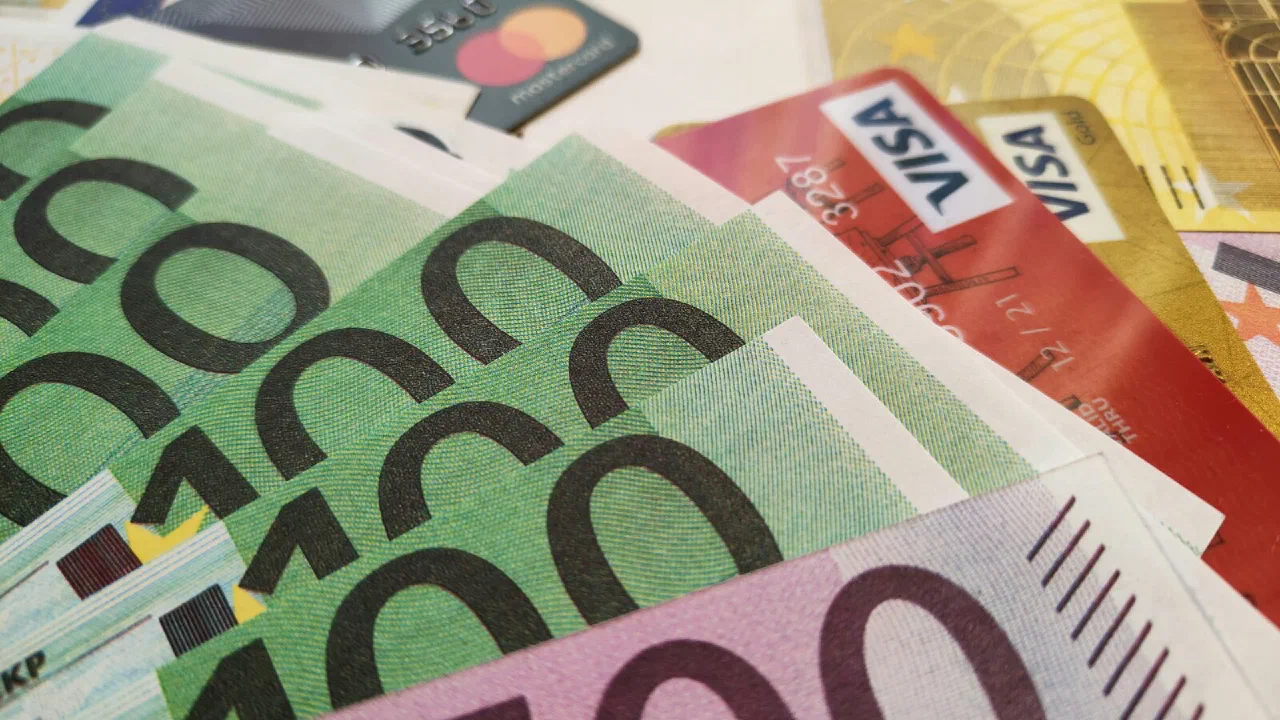
Take the refund to a card, and only if that card is billed in the same currency as the form. A euro form paid to a euro-billed card is the cheapest route on the board: about one euro of scheme charge and nothing else. The same form paid to a dollar-billed card costs 3% to 5% on top, because somebody has to convert it and the operator is the one holding it.
Cash is the route that looks free and is not. Nobody publishes what it costs, which is the tell.
Cash or card: what each route actually charges
There are three deductions in play and they do not all apply to both routes.
The service fee applies either way. It comes out before you choose anything, it is the largest deduction by a wide margin, and neither major operator publishes it against the gross price — the comparison of what Global Blue and Planet publish goes through that in full. The figure used in the ladder above is Privé’s published quarter of the reclaimable amount, dated 21 June 2026, because it is the most recent dated source that names its own base.
The card route adds a scheme charge, and it is small. Planet’s Tax Free FAQ states it plainly: “American Express charges £1 and MasterCard €1.” Global Blue’s published terms, as reproduced by TravelUpdate on 20 March 2023, describe the same thing — “an amount up to EUR 1.00 will be deducted from the tax refund per each Tax Free Form due to the scheme fee.” One euro, once, per form. On a €166.67 refund that is 0.6%. It is not the reason to avoid a card.
The cash route adds a handling fee, and nobody will tell you what it is. Planet’s FAQ says only that “at most airports, the agent who gives you the cash refund will charge a separate service fee.” No amount, no band, no per-airport table — and the agent handing over the notes is frequently a bureau de change operating under its own schedule rather than the refund company’s. I processed forms for four years and never saw a published figure for it either; what I saw were callers who had accepted cash and could not reconcile what they were handed with what the form said.
An unpublished fee is not necessarily a large one. But it is a fee you agree to before you know it, at a counter, with a flight to catch, and there is no version of that which is in your favour.
The currency line is the whole decision
Here is the part that turns a small choice into a 5% one.
Global Blue’s published terms state that “if you want to receive your refund to Visa, MasterCard, and Diners, your credit card account will be credited in the billing currency of your credit card.” That sentence is doing a lot of work. It means the refund does not arrive as euro and get converted by your bank at your bank’s rate. It arrives already converted, by the operator, into whatever currency your card is billed in — and the same terms put that conversion at “3% to 5% of the refund amount in original currency.”
So the card route is two different products depending on one fact about your wallet:
| Your card is billed in | What the card route costs | On a €166.67 refund |
|---|---|---|
| Euro, on a euro-denominated form | scheme charge only | about €1.00 |
| Dollars, sterling, yen — anything else | scheme charge + 3%–5% conversion | about €4.72 to €7.20 |
Both of those beat an unpublished cash handling fee at the point where that fee exceeds them, and neither of them tells you where that point is. Which is why the rule below is stated the way it is.
The rule, and the threshold under it
If you hold a card billed in the form’s currency, use it. There is no case in the published figures where cash beats a one-euro scheme charge, and the cash counter’s fee is unknown by construction.
If you do not, ask the cash desk for its handling fee as a figure before you hand over the form. Then compare it against 3% to 5% of the refund, which is what the card route will cost you instead. On the €166.67 refund above that comparison line sits between about €4.70 and €7.20 — so a cash desk quoting a flat €3 is genuinely cheaper, and one quoting €10 is not. Below roughly €100 of refund the conversion band shrinks to a few euro and a flat cash fee usually loses; above about €250 of refund the percentage starts to dominate and cash can win outright. The crossover is arithmetic, not preference, and it moves with the fee the desk quotes.
If the desk will not state a figure, take the card. A refusal to price a service before performing it is the only signal you will get, and it is enough.
The three things people get wrong here
“Cash is instant, so it must be cheaper.” Cash is instant and that has real value if you are travelling on. It is not evidence about price. Planet publishes a 30-day processing target — “we aim to process your refund within 30 days after we receive your validated Planet Tax Free form” — so the card route’s cost is measured in weeks of waiting, not in money.
“I’ll take it in euro cash and convert it myself later.” Then you are paying the cash handling fee and a conversion, at a bureau or an ATM, on a small sum. That is the worst of both routes, and it is the one I saw most often.
“The desk offered me dollars, which saves me converting.” That is dynamic currency conversion under another name, and it is the same mechanism the card route charges 3% to 5% for. Being offered your home currency at a foreign counter is never a saving; it is a conversion being sold to you at someone else’s rate.
“Thirty days from the stamp.” It is not. Planet’s published target runs from the point at which the operator receives the validated form — “after we receive your validated Planet Tax Free form” — so where you have posted a paper form back yourself, the clock starts when it arrives, not when customs stamped it. That gap is the most common reason a card refund feels overdue when it is not, and it is the argument for asking the shop for a digitally validated form: it removes the leg of the journey nobody is tracking.
What this does not cover
It does not cover the downtown route, where the refund is advanced to your card in the shop against a guarantee and reversed if the stamp never reaches the operator. The currency arithmetic there is the same; the risk is not, and it gets its own post.
It does not cover what the conversion is worth against a fair benchmark — whether 3% to 5% is a normal price for moving money between two currencies or a markup on one. That comparison is the conversion spread nobody counts, published two days after this. It is the larger of the two numbers on this page and the one nobody argues about.
Planet’s figures read from its published Tax Free FAQ on 4 September 2026. Global Blue’s read from its terms as reproduced by TravelUpdate on 20 March 2023. Operator fee at Privé’s published figure of 21 June 2026. Rules are jurisdictional and they change; this is reporting, not tax or legal advice.
vat-refundrefund-operatorsairport-procedureexchange-ratesfrance